Aerosol paint is often purchased as a simple finishing product, but commercial buyers usually have more questions than color and gloss. They may need to know whether the formulation fits their market, whether the coating works on the intended substrate, how quickly it dries, and whether the packaging suits their supply chain.
For buyers considering no-lead spray paint, these questions are especially relevant. Instead of treating lead-free formulation as the entire reason to choose a product, it is more useful to examine how formulation, application, performance, and purchasing requirements work together.
Begin With the Market You Serve
The same spray paint can have very different value depending on who will use it. An automotive repair shop may need an appearance-repair coating, while a hardware retailer may want a versatile product for customers working on household projects.
Understanding the end use also helps determine which substrates and performance characteristics matter most. A product that works on several common materials can potentially serve more applications without requiring a completely different coating for every project.
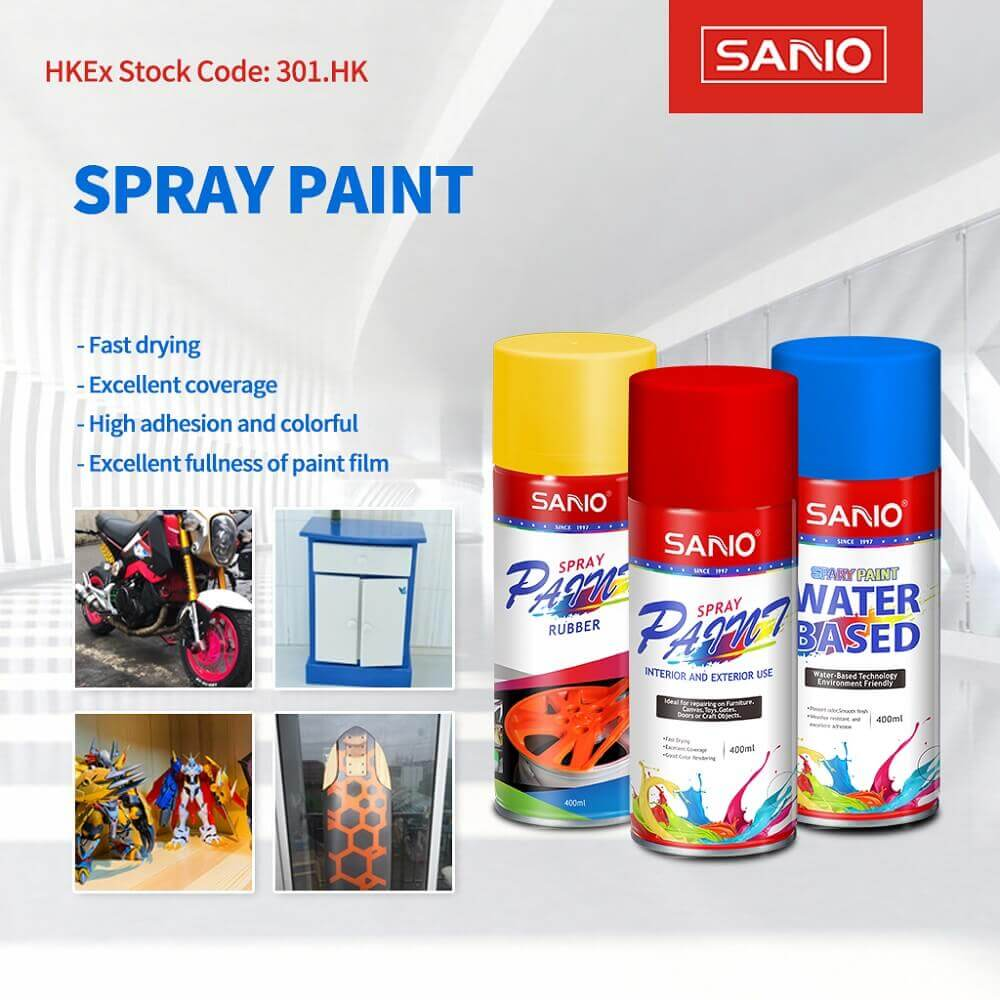
The Lead-Free Spray Paint offered by SANVO is recommended for metal, wood, and ABS substrates. Its listed uses include automotive appearance repainting, decoration, wall art, and anti-rust surface protection on tubes.
This makes application range a useful starting point for distributors and professional users deciding whether a coating fits their existing product assortment.
Examine the Formulation, Not Just the Name
The phrase no-lead spray paint tells buyers something important, but it does not explain the entire formulation. To understand a product properly, purchasers should review the manufacturer’s listed components and supporting technical information.
For this product, the main components are identified as eco-friendly resin, solvent, and lead-free pigment. The manufacturer also lists more than 100 colors and states that colors can be customized according to customer requirements.
This information is particularly useful for B2B purchasing because it gives businesses concrete characteristics to compare. It also helps separate a documented formulation from assumptions based simply on a product name.
Lead-free status should not, however, be interpreted as meaning that the aerosol requires no safety precautions. The product specification identifies a solvent smell, so normal aerosol handling and application procedures remain relevant.
Consider What Lead Regulations Actually Cover
Lead requirements depend on the product and its intended use. In the United States, federal regulations limit lead in paint and similar surface coatings used on children’s products and certain furniture articles to 90 parts per million.
The distinction between a coating and the finished article can also matter. Businesses selling products into regulated categories should determine which requirements apply to the complete product rather than assuming that one general lead standard covers every situation.
For this reason, manufacturers, importers, and distributors should identify the destination market early in the sourcing process. Where regulations require testing or documentation, those requirements should be confirmed before commercial launch.
A documented lead-free formulation can be a useful starting point, but regulatory suitability should always be assessed according to the actual application and market.
Put Drying Data Into a Real Workflow
Another way to evaluate an aerosol is to consider how its drying behavior affects the work being performed. For a repair shop, faster surface drying may influence handling between stages. For a distributor, clear drying specifications provide useful information when communicating with professional customers.
The product specification gives a surface drying time of 4–5 minutes at 25°C and 60% relative humidity. Full drying is specified as no more than 60 minutes under the same conditions.
These figures should be treated as reference specifications under stated conditions rather than guaranteed results in every environment. Temperature, humidity, surface preparation, spray technique, and coating thickness can all influence actual drying behavior.
For businesses evaluating a new supplier, defined test conditions make product comparison more meaningful than broad claims such as fast drying.
Look at Color as a Product-Range Decision
Color availability can have a surprisingly large effect on the commercial usefulness of an aerosol coating. A supplier offering only a small number of standard colors may require a distributor to maintain several coating ranges to satisfy different customers.
The Lead-Free Spray Paint range provides more than 100 colors, with customization available according to requirements.
This can be useful for businesses with specialized color needs. Retailers may want a broader assortment, while OEM customers or private-label businesses may require particular shades for branding or application-specific purposes.
In other words, customization can turn a standard coating into a more flexible sourcing option. It can also reduce the need to search for a separate supplier when a customer requests a non-standard color.
Packaging Is Part of the Purchasing Decision
A coating can perform well and still be inconvenient to stock if its packaging does not fit the buyer’s logistics. For volume purchasers, net content and can dimensions can influence transportation, warehouse organization, shelf presentation, and inventory calculations.
The product is available in 250 g/400 ml and 200 g/350 ml formats. The listed can sizes are Φ65 × 158 mm and Φ60 × 145 mm. Its stated shelf life is three years when stored at room temperature.
These specifications give importers and distributors practical information before placing larger orders. They can also be compared with existing packaging requirements and warehouse systems.
This is one reason product evaluation should extend beyond the paint inside the can. The complete package needs to work within the buyer’s commercial operation.
How We Fit the Product Into a Broader Aerosol Range
At SANVO, we develop aerosol and other fine chemical products for automotive, hardware, and building material applications. Our aerosol capabilities include different coating formulations, and we support customized solutions for customers with specific requirements.
Our Lead-Free Spray Paint is one option within that wider approach. We provide defined information about its formulation, applications, drying conditions, package formats, and color options so customers can assess whether it fits their particular market.
For B2B customers, this type of information can be more useful than a purely promotional product description. It allows purchasing teams to move from initial screening to sampling and application testing with clearer expectations.
Use a Full-Profile Evaluation Before Ordering
A good no-lead spray paint should be evaluated as a complete product rather than through a single formulation claim. Buyers can begin with the intended application, confirm suitable substrates, review the listed composition, and then compare drying performance, colors, packaging, and market requirements.
This method is especially useful when purchasing for distribution or professional applications. It reduces the risk of choosing a coating that sounds suitable but does not match the customer’s actual needs.
Lead-free formulation can certainly be an important selection factor. Yet its real value becomes clearer when it is combined with practical application information and measurable specifications. By evaluating the complete product profile, businesses can make more informed sourcing decisions and select aerosol coatings that are better aligned with their customers, workflows, and target markets.