When selecting spray paint, buyers often focus first on color, finish, and coverage. Yet formulation can be equally important, particularly for businesses supplying products to retailers, workshops, construction companies, or professional users. Growing attention to emissions and chemical exposure has also made water-based and lower-risk coating technologies increasingly relevant.
However, terms such as water-based, low-VOC, and non-toxic should not be treated as interchangeable. Each describes a different aspect of a coating. Understanding these differences can help purchasers make more informed decisions and avoid choosing a product based only on a marketing label.
What Makes a Water-Based, Non-Toxic Spray Paint Different?
Water-based coatings generally use water as a major carrier, while conventional solvent-based coatings rely more heavily on organic solvents. According to the U.S. Environmental Protection Agency, water-based acrylic latex paints generally have lower VOC levels than solvent-based paints and can offer advantages for handling and cleanup.
For this reason, water-based technology can be attractive when businesses are looking for coating options that may reduce chemical emissions. However, lower VOC content does not automatically mean that a coating contains no potentially undesirable substances. EPA guidance specifically recommends considering the overall composition and required performance rather than relying solely on a low-VOC or zero-VOC description.
The term non-toxic should also be examined carefully. A product should be evaluated according to its actual formulation, safety documentation, intended application, and applicable regulations. Even products positioned as safer alternatives still require proper handling, storage, and ventilation during spraying.
Start With the Application, Not the Label
A practical way to choose spray paint is to begin with the surface and application environment. Metal, wood, plastic, concrete, laminate, and glass can have different adhesion and finishing requirements. The coating must therefore be compatible with the substrate before other characteristics are considered.
Application conditions also influence results. Surface cleanliness, moisture, temperature, spraying technique, and coating thickness can affect the final appearance and adhesion. A formulation that performs well on one substrate may not produce the same result under different conditions.
This is particularly relevant for B2B buyers. Distributors and retailers need products that can serve a broad customer base, while repair shops and construction companies may prioritize drying speed, durability, substrate compatibility, and consistent quality.
Why Formulation and Performance Need to Work Together
A coating selected for environmental or safety considerations still needs to perform its basic function. EPA guidance notes that paint selection should consider VOC content together with composition and performance characteristics such as durability.
Drying time can also influence productivity. Faster surface drying may allow components to move through repair, decoration, or finishing processes more efficiently. At the same time, users should distinguish surface drying from complete drying and follow the manufacturer’s specified application conditions.
For professional buyers, consistency is another important factor. A coating that performs predictably across repeated orders can make inventory planning and customer satisfaction easier, particularly when products are supplied through retail or distribution channels.
A Closer Look at SANVO Acrylic Spray Paint
At SANVO, we develop fine chemical products for markets including automotive, hardware, and building materials. Our experience covers aerosol solutions as well as adhesives, sealants, waterproofing products, and coatings. We also provide OEM, ODM, custom, wholesale, and distributor services for B2B customers.
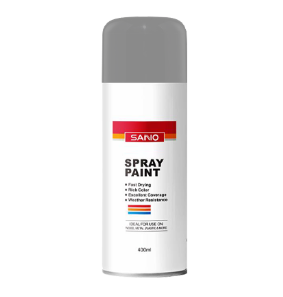
Our acrylic spray paint is described on the official product page as acid-free, non-toxic, and pH balanced. It is intended for surfaces including metal, concrete, wood, laminate, plastic, and glass, with a focus on quick drying and a smooth, durable finish. The product range also offers more than one hundred color and gloss options, with customization available.
The product detail information provides additional technical parameters for the normal-color spray paint. Its main components are acrylic resin, solvent, and pigment. Surface drying is specified at 4–5 minutes at 25°C and 60% relative humidity, while full drying is listed as no more than 60 minutes under the same conditions. Available net contents include 250 g/400 ml and 200 g/350 ml.
These specifications also demonstrate why buyers should examine the actual product details before assuming that every acrylic spray paint is water-based. Acrylic technology and water-based technology are related concepts, but they do not automatically describe the same formulation.
How to Evaluate Safer Coating Options
For businesses comparing products, the first step is to identify the exact formulation. Check the technical data, safety documentation, recommended substrates, drying conditions, and intended applications. This provides a more reliable basis for comparison than product terminology alone.
The second step is to consider the market in which the coating will be sold or used. Retail products may require broad color selection and convenient packaging, while industrial customers may place greater emphasis on consistency, technical performance, and supply reliability.
The third step is to examine the supplier’s manufacturing capabilities. Large-volume buyers may need stable production capacity, quality control, customization, and responsive support. These factors can affect the total value of a coating solution over the course of a long-term supply relationship.
Responsible Selection Requires the Full Picture
A water-based, non-toxic spray paint can sound appealing when buyers are looking for coating solutions with a stronger focus on environmental and user considerations. Nevertheless, responsible product selection requires more than a keyword. Formulation, VOC content, application method, substrate compatibility, durability, and safety instructions should all be reviewed together.
Aerosol products also require appropriate precautions. EPA guidance recommends reading product labels and following safety instructions because hazards and recommended handling procedures can vary between formulations.
For businesses, the most reliable approach is therefore to compare documented product characteristics with actual application needs. By doing so, purchasers can identify coating solutions that balance performance, safety considerations, market expectations, and supply requirements.
Whether the goal is to expand a retail range, support automotive repair, serve construction customers, or develop a customized aerosol line, careful evaluation provides a stronger foundation for selecting the right spray paint and building a dependable product portfolio.