When buyers search for non-toxic spray paint, they are often looking for a coating that combines practical performance with a more responsible formulation. However, the term should not be interpreted as meaning that an aerosol product requires no safety precautions. A useful evaluation should consider the formulation, intended surface, drying characteristics, documentation, and application environment together.
What Does Non-Toxic Spray Paint Mean?
A non-toxic claim describes a product’s formulation according to the manufacturer’s stated criteria. It does not mean that the aerosol contains no chemicals or that users can ignore normal handling instructions. Spray paint is still dispersed as a fine mist, so appropriate ventilation and the manufacturer’s safety guidance remain important.
The formulation itself is central to understanding the claim. SANVO’s acrylic spray paint is described on its official product page as acid-free, non-toxic, and pH balanced. Its main components are listed as acrylic resin, solvent, and pigment. The product page also identifies a solvent smell, showing that non-toxic and odor-free are not interchangeable descriptions.
For B2B buyers, this distinction is particularly useful. A distributor or retailer should evaluate the complete product documentation rather than treating the phrase non-toxic as a substitute for technical or safety information.
Why Does the Formulation Matter?
Spray paint performance depends on how its ingredients work together. Acrylic resin contributes to the coating film, while pigments provide color and the solvent helps create a workable formulation for aerosol application. Changing one component can influence drying, adhesion, coverage, appearance, or compatibility with the substrate.
Our acrylic spray paint is formulated for decoration and appearance repair on metal, wood, and ABS substrates. The broader product information also identifies applications involving vinyl, plastic, fiberglass, concrete, laminate, and glass.
This versatility can make acrylic aerosol coatings useful across several commercial markets. However, users should always confirm compatibility with the specific substrate and perform a small test when introducing a product to a new application.
What Performance Can Buyers Expect?
Choosing a non-toxic spray paint does not necessarily mean sacrificing application efficiency. Buyers should still examine practical characteristics such as drying speed, coverage, adhesion, color consistency, and finish quality.
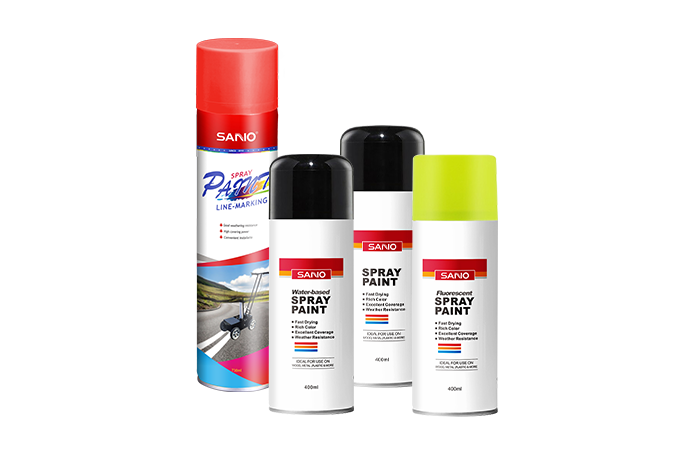
The published specifications for this acrylic spray paint state a surface drying time of 4 to 5 minutes and full drying within 60 minutes at 25°C and 60% relative humidity. The listed net-content options are 250 g/400 ml and 200 g/350 ml.
The product is also promoted for fast drying, excellent coverage, good color rendering, and superior adhesion. More than 115 standard colors are available, with customized colors offered according to requirements.
These characteristics can be relevant for retailers, repair businesses, DIY suppliers, and other customers that need a coating that is convenient to apply while offering broad color selection.
Where Can Acrylic Spray Paint Be Used?
Acrylic aerosol coatings are suitable for a variety of decorative and repair applications. The product is recommended for metal, wood, and ABS substrates, while the manufacturer also identifies plastic, vinyl, fiberglass, concrete, laminate, and glass among suitable surfaces.
Potential applications include furniture, plastics, DIY projects, and automotive work. For professional users, the ability to apply a coating to different substrates can simplify sourcing when several related applications need to be supported.
Nevertheless, surface preparation remains essential. Dirt, grease, moisture, loose coatings, or incompatible finishes can affect adhesion and appearance. Cleaning the surface and testing the coating before large-scale application can help reduce avoidable problems.
Is Non-Toxic the Same as Low-Odor?
No. These terms describe different characteristics. A coating can be identified as non-toxic by its formulation while still having an odor caused by volatile ingredients. In fact, the published product parameters specifically describe the acrylic spray paint as having a solvent smell.
Odor should therefore not be used as a direct measure of toxicity. Conversely, a product with little noticeable odor should not automatically be considered harmless. Buyers should rely on the manufacturer’s technical information and SDS when evaluating chemical safety.
During aerosol application, users should also avoid inhaling the spray mist and follow applicable workplace procedures. Good ventilation and appropriate protective equipment should be considered according to the product documentation and working conditions.
Why Does This Matter for B2B Buyers?
For distributors and retailers, product selection involves more than the performance of one aerosol can. Buyers may also need consistent formulation, color availability, packaging options, documentation, and reliable manufacturing capacity.
SANVO serve markets including hardware stores, vehicle repair shops, supermarket and retail stores, and auto-parts businesses. Our acrylic spray paint is available in numerous standard colors, while custom color matching can support customers with specific product-line requirements.
We also provide aerosol customization services for business customers. This allows buyers to discuss requirements involving color, formulation, packaging, and application rather than relying solely on an off-the-shelf product.
How Should You Choose a Safer Spray Paint?
Start by identifying the intended substrate, application environment, finish, and required drying time. Then review the formulation and supporting technical documentation. If chemical restrictions are part of your purchasing policy, verify the relevant product information before placing a commercial order.
It is also worthwhile to conduct a pilot application. Temperature, humidity, spray distance, coating thickness, and surface preparation can all influence the finished result. A small-scale test can reveal whether the coating meets the requirements of the actual application.
For B2B sourcing, consistency should also be considered. A product that performs well in one trial needs dependable manufacturing and documentation if it will become part of a larger retail or professional supply chain.
Choosing a Non-Toxic Spray Paint
A non-toxic spray paint should be evaluated as a complete coating rather than selected from a marketing claim alone. Formulation, substrate compatibility, drying performance, application conditions, and supporting documentation all contribute to a responsible purchasing decision.
Our acrylic spray paint is officially described as acid-free, non-toxic, and pH balanced, while its published specifications provide measurable information about composition, drying time, packaging, colors, and recommended applications.
For customers comparing aerosol coatings, we recommend combining technical evaluation with practical testing. This approach makes it easier to select a product that balances coating performance, application convenience, and the specific safety expectations of the intended market.