Xylene is widely used in paints, coatings, adhesives, and other industrial formulations because of its solvent properties. However, businesses may look for alternatives because of workplace exposure concerns, VOC management, regulatory requirements, or formulation goals. So, what is a substitute for xylene? The answer depends on what xylene does in the specific formulation and which properties must be preserved.
What Is a Substitute for Xylene in Coatings?
There is no single replacement that works for every application. Xylene can function as a solvent or thinner in solvent-based coating formulations, helping control viscosity and application performance. The U.S. Environmental Protection Agency notes that coating manufacturers can reduce or eliminate conventional solvent use through water-based, high-solids, powder, and radiation-curable coating technologies.
This means a suitable substitute may be another solvent, a different coating formulation, or an entirely different application technology. Before selecting an alternative, formulators need to consider resin compatibility, evaporation behavior, viscosity, drying time, appearance, adhesion, durability, and regulatory requirements.
The EPA also emphasizes that solvent substitution should involve a holistic evaluation of solvent properties, process requirements, energy use, cost, regulations, and potential hazards. Simply choosing a chemical with a lower perceived hazard can create a regrettable substitution if the replacement performs poorly or introduces another concern.
Water-Based Coatings as an Alternative
For some applications, water-based coatings can reduce dependence on organic solvents. Instead of relying primarily on an organic solvent system, these formulations use water as a major carrier phase. The EPA lists water-based formulations among acceptable coating alternatives and identifies them as one route for moving away from conventional solvent systems.
However, switching from a solvent-borne coating to a water-based system is a formulation change rather than a simple one-for-one solvent replacement. Drying conditions, substrate preparation, film formation, humidity sensitivity, equipment requirements, and final performance may differ.
For this reason, a water-based coating should be evaluated as a complete product system. It may be an excellent solution for one application while being unsuitable for another where rapid solvent evaporation, specific resin compatibility, or particular surface characteristics are required.
High-Solids and Powder Coatings
High-solids coatings are another approach to reducing conventional solvent requirements. These formulations contain a greater proportion of coating solids, reducing the amount of volatile material needed to deliver the desired film. The EPA identifies high-solids coatings among strategies that can reduce solvent emissions.
Powder coating takes the concept further by using a dry coating material rather than a conventional liquid solvent-borne coating. EPA information documents cases where manufacturers replaced spray painting with powder coating and eliminated xylene from that process.
The tradeoff is that powder coating requires compatible equipment and curing conditions. It is therefore more appropriate for certain industrial production environments than for applications requiring portable aerosol spraying or air-drying on large or irregular surfaces.
Can Other Organic Solvents Replace Xylene?
In some formulations, another organic solvent may be considered. Potential candidates can include solvents such as acetone, ethyl acetate, or other formulation-specific solvent blends. However, these chemicals do not have identical evaporation rates, solvency, flash points, or resin compatibility.
EPA substitution data show that facilities have reported replacing xylene with aqueous products, powder coatings, acetone, and other alternatives. Importantly, the EPA cautions that its substitution database does not constitute a comparative toxicity assessment of those alternatives.
Consequently, the question what is a substitute for xylene? should not be answered by naming one solvent without knowing the intended application. A replacement needs to be tested against the performance requirements of the original process.
Why Direct Substitution Can Be Difficult
Solvents influence much more than whether a coating remains liquid. Their evaporation behavior can affect spray characteristics, leveling, drying speed, film appearance, and the way a coating interacts with its substrate. Changing the solvent can therefore change the behavior of the entire formulation.
EPA guidance on xylene-containing surface coatings notes that dilution requirements can vary with temperature, humidity, coating type, and other conditions. This illustrates why substitution should be approached as a formulation-development task rather than a simple ingredient exchange.
For manufacturers, pilot batches and application trials are valuable before a full production change. Testing can reveal differences in spray pattern, drying, adhesion, peelability, surface finish, and long-term performance that cannot be predicted from chemical names alone.
Xylene in Rubber Spray Paint
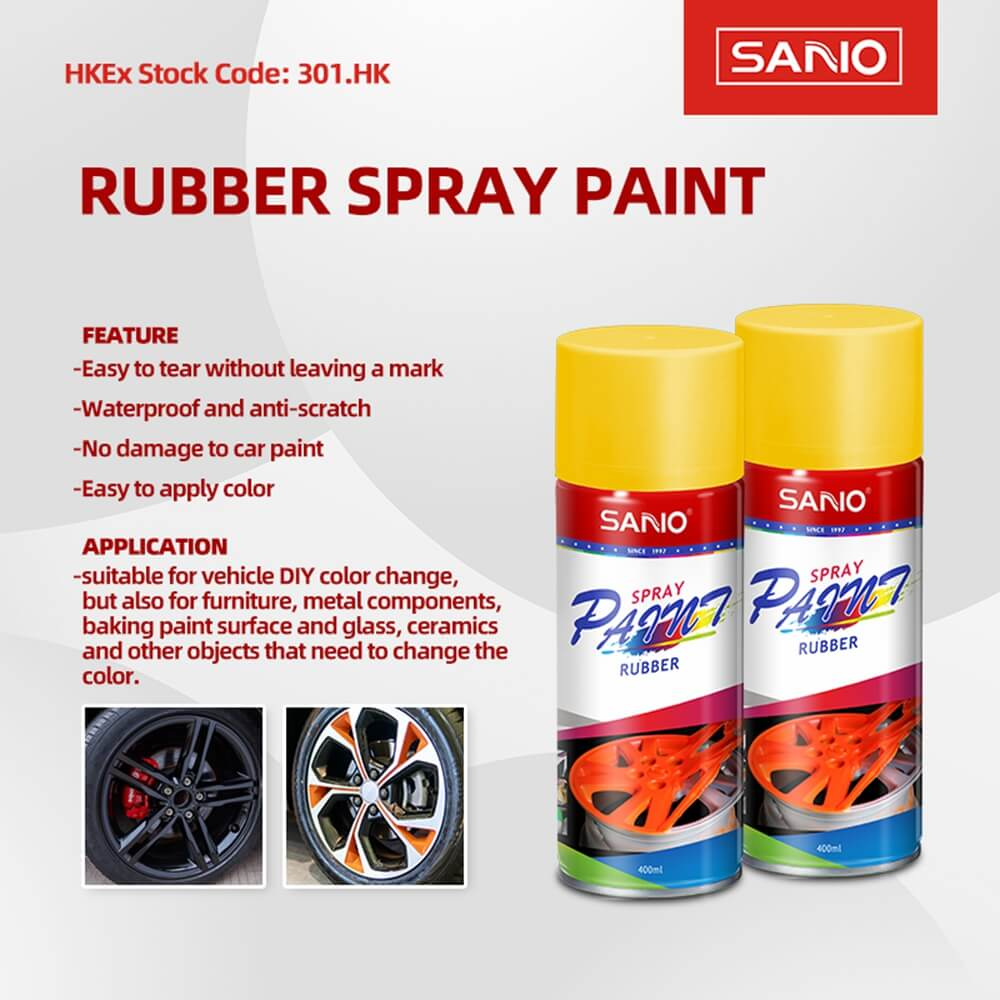
SANVO Rubber Spray Paint demonstrates why the complete formulation matters. The official product information lists styrene-butadiene copolymer resin, pigments or powders, solvent oil, ethyl acetate, xylene, and DME among its main ingredients. The product is a natural-drying rubber coating designed for surfaces including vehicle bodies, wheel hubs, interiors, furniture, metal components, glass, and ceramics.
The published specifications identify a 400 ml content and 12-piece carton package. The product information also states that the coating can provide waterproofing, abrasion resistance, and corrosion resistance, while the technical parameters describe a smooth and even paint film.
Because xylene is only one component of this formulation, replacing it independently would not necessarily produce the same result. A reformulated rubber spray paint would need to maintain compatibility among the resin, pigments, solvents, propellant, and other ingredients while preserving the intended application characteristics.
How We Approach Product Formulation
At SANVO, I focus on practical chemical solutions for applications across automotive, hardware, and building-material markets. Our product range includes aerosol coatings, adhesives, sealants, waterproofing products, and related chemical solutions. For products such as rubber spray paint, formulation performance depends on how the individual ingredients work together rather than on any single solvent.
For professional buyers considering a xylene reduction or substitution strategy, Werecommend beginning with the performance requirements of the finished product. Reviewing the technical data sheet and safety data sheet can help define the existing formulation and identify which properties an alternative system must retain.
Choosing the Right Xylene Alternative
So, what is a substitute for xylene? Depending on the application, possible approaches include water-based coatings, high-solids formulations, powder coatings, or another carefully selected solvent system. None should automatically be considered a universal replacement.
The best choice depends on the coating chemistry, substrate, equipment, drying requirements, environmental conditions, safety objectives, and applicable regulations. A controlled pilot test is essential before changing a commercial formulation or production process. By evaluating both performance and hazard characteristics, manufacturers can reduce xylene use without compromising the quality or reliability of the finished coating.