Xylene is an industrial solvent that appears in more products than many users realize. It is valued for its ability to dissolve or disperse other substances and is used across paints, coatings, adhesives, cleaning products, and automotive applications. If you are wondering what products contain xylene, the answer depends on the formulation and intended use. Checking the ingredient information or safety data sheet is the most reliable way to confirm its presence.
What Products Contain Xylene in Everyday Industrial Use?
Xylene is found in a range of formulated products because it works as an organic solvent. NIOSH explains that organic solvents are used in products such as paints, varnishes, lacquers, adhesives, glues, and degreasing or cleaning agents. Xylene specifically is used in industries including painting, furniture refinishing, petroleum processing, and wood processing.
The concentration can vary substantially between products. A product category may include both xylene-containing and xylene-free formulations, so the product name alone cannot establish whether xylene is present. For professional procurement, reviewing the manufacturer’s SDS, technical data sheet, or ingredient declaration is a more dependable approach.
Paints, Coatings, and Lacquers
Paint-related products are among the most familiar categories associated with xylene. EPA documentation identifies xylene in paints and coatings, including materials used for surface coating operations such as paint, varnish, lacquer, and primer.
Xylene can serve as a solvent within these formulations, helping maintain the desired liquid properties before application. The final coating performance depends on the complete formulation, including resins, pigments, additives, and other solvents.
This is particularly relevant when comparing industrial coatings. Two products designed for similar surfaces may use very different solvent systems. One may contain xylene, while another may use a different organic solvent or a water-based formulation.
Automotive Products
Automotive products are another important category when asking what products contain xylene. NIOSH identifies automotive-related workplace exposure as one area where xylene may be encountered, while toxicological data have reported xylene in some automotive product samples.
Possible examples include certain paints, refinishing products, solvents, and related maintenance formulations. However, not every automotive aerosol or refinishing product contains xylene. Formulations differ by manufacturer, product type, and intended application.
For automotive professionals, checking the SDS before using a coating or solvent is especially important. The document can provide information about hazardous ingredients, handling precautions, storage conditions, and exposure controls.
Adhesives and Sealants
Some adhesive-related products can also contain xylene. Published toxicological data have identified xylene in a portion of sampled adhesive-related products, although the reported concentrations were generally much lower than those found in many paint-related products.
In an adhesive formulation, a solvent may help control viscosity and support application before the adhesive develops its final bond. The exact role of xylene depends on the chemistry of the adhesive and the manufacturer’s formulation strategy.
For buyers, this means an adhesive should not be classified simply by its product category. If avoiding xylene is a purchasing requirement, the specific formulation should be verified rather than assuming that all adhesives have the same composition.
Cleaning, Degreasing, and Maintenance Products
Certain industrial cleaning and degreasing formulations can also use organic solvents. NIOSH notes that organic solvents are widely used in degreasing and cleaning agents, although the presence and concentration of xylene vary from one formulation to another.
These products may be designed to remove oils, grease, residues, or other substances from equipment and surfaces. Because solvent strength, evaporation behavior, and material compatibility vary, users should select cleaning products according to the substrate and contamination rather than focusing only on whether xylene is present.
Appropriate ventilation and handling procedures should also be followed when working with products that contain volatile solvents.
Rubber and Spray Coating Products
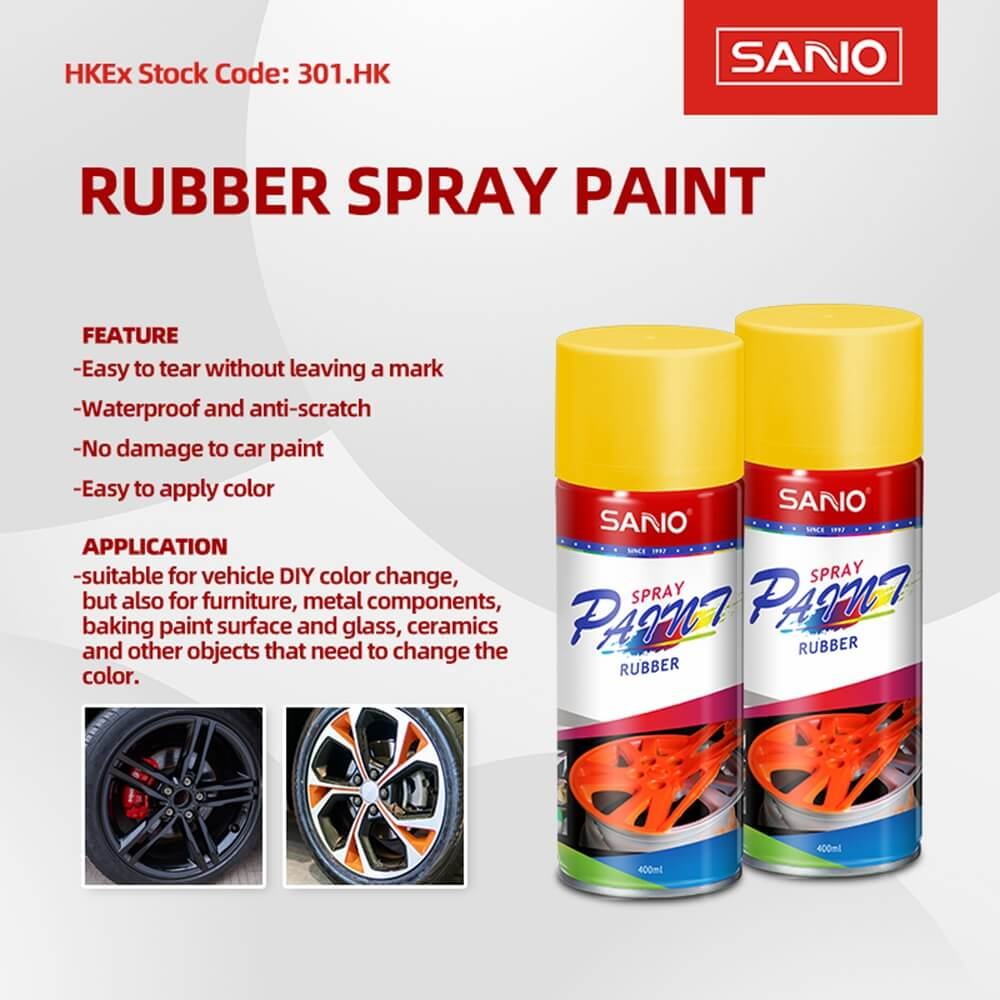
Rubber coatings and aerosol paints provide another useful example. The official product information for SANVO Rubber Spray Paint lists styrene-butadiene copolymer resin, pigments or powders, solvent oil, ethyl acetate, xylene, and DME among its main ingredients.
The product is formulated as a natural-drying rubber coating for changing the color of vehicle bodies, wheel hubs, interiors, furniture, metal components, painted surfaces, glass, ceramics, and other suitable objects. It is supplied in a 400 ml aerosol can, with a listed 300 g net weight used for the spraying-area specification.
Its technical data report a surface drying time of approximately 10 minutes, full drying in 60 minutes, a spray rate of at least 96%, and a recommended construction temperature of 15 to 40°C. The specified density at 20°C is 0.92 to 1.05 g/cm³.
The product SDS provides additional formulation information and identifies xylene at 5–10% in the listed composition. Because this is a specific formulation, these figures should not be generalized to other rubber coatings or spray paints.
How Can You Tell If a Product Contains Xylene?
The most reliable method is to check the manufacturer’s current SDS. Look for names such as xylene, xylol, or the relevant xylene isomers. NIOSH identifies ortho-xylene, meta-xylene, and para-xylene as distinct chemical names, each with its own CAS number.
A product’s technical data sheet may also list its principal ingredients, but an SDS is generally the more appropriate document for evaluating chemical hazards and regulated components. Product labels can provide additional information, particularly for consumer and workplace handling.
If a manufacturer offers both conventional and alternative formulations, comparing their SDS documents can help buyers determine whether a particular product meets internal chemical restrictions.
Our Approach to Aerosol Coatings
At SANVO, We work with products designed for automotive, hardware, and building-material applications. Our portfolio covers aerosols, adhesives and sealants, and waterproofing and coating solutions, with OEM and ODM services available for business customers.
For our Rubber Spray Paint, we provide detailed product parameters and supporting technical documentation so customers can evaluate the formulation and application characteristics. This information is particularly useful for distributors, professional users, and businesses comparing coating solutions for specific markets.
Checking Products Before Purchase
So, what products contain xylene? Common categories can include certain paints, coatings, lacquers, automotive products, adhesives, cleaning formulations, and rubber or aerosol coatings. However, these are product categories rather than universal rules.
The presence of xylene must be confirmed for the individual formulation. If your business has requirements concerning VOCs, workplace exposure, transportation, or restricted substances, review the latest SDS and technical documentation before purchasing or specifying a product.
For products such as rubber spray paint, understanding the complete formulation and its intended application provides a much clearer basis for comparison than relying on the product category alone.