When discussing solvents used in coatings, adhesives, and industrial aerosols, many buyers ask: “is ethyl acetate polar or nonpolar“? The answer is that ethyl acetate is considered a moderately polar solvent. Its molecular structure contains both polar and nonpolar characteristics, which allows it to dissolve a wide range of substances in manufacturing environments. In industrial production, this balance makes the material useful for coatings, paints, inks, and adhesive formulations that require controlled evaporation and stable performance. At SANVO, we often work with solvent-based systems where material compatibility and drying efficiency are important for large-scale production processes.
Understanding Molecular Characteristics
To explain “whether ethyl acetate is polar or nonpolar”, it is useful to look at its chemical structure. Ethyl acetate contains an ester functional group, which creates polarity because oxygen atoms attract electrons more strongly than carbon and hydrogen atoms. At the same time, the molecule also includes hydrocarbon groups that contribute nonpolar behavior. Because of this combination, ethyl acetate is not strongly polar like water, but it is more polar than many hydrocarbons.
This moderate polarity helps manufacturers dissolve resins, pigments, and synthetic materials more effectively during industrial processing. In coating production, the solvent can support smooth film formation while maintaining manageable drying times. These characteristics are important in sectors such as automotive refinishing, construction coatings, packaging inks, and aerosol products where stable application performance matters during mass production.
Why the Solvent Is Common in Industrial Formulations
Another reason companies continue asking “is ethyl acetate polar or nonpolar” is because solvent polarity directly affects product behavior. In industrial spray products, the wrong solvent balance may lead to uneven coating surfaces, poor adhesion, or excessive residue after evaporation. Ethyl acetate is widely selected because its evaporation speed and solvency fit many commercial production requirements.
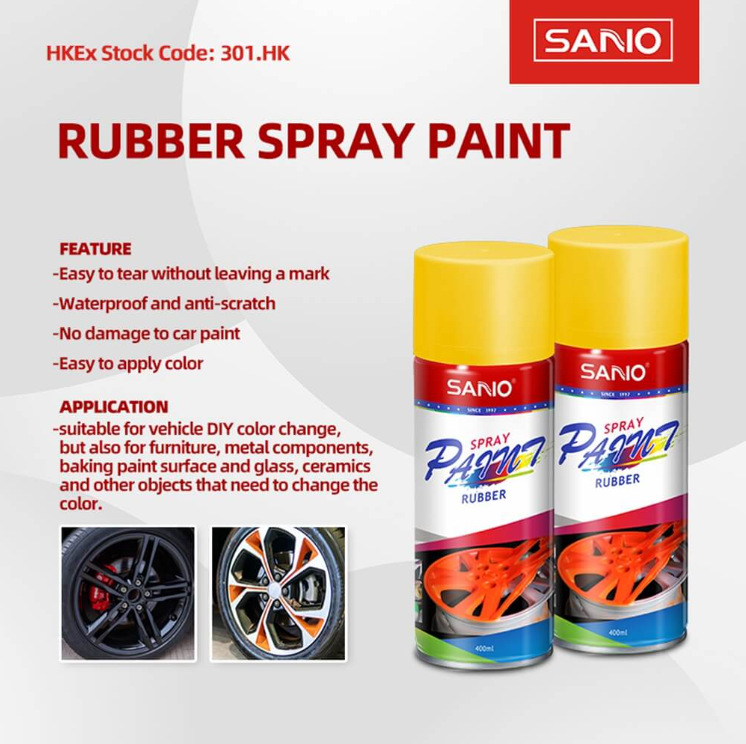
At SANVO, we understand that B2B customers often focus on manufacturing consistency and raw material compatibility rather than only laboratory data. In products such as rubber spray paint, solvent selection influences spray atomization, coating smoothness, and storage stability. Ethyl acetate is commonly used in these systems because it can work with various synthetic rubber and resin materials while supporting efficient production workflows. For wholesalers and OEM partners, this balance can help improve operational flexibility across different project requirements.
Production Support and Material Development
Industrial buyers researching “is ethyl acetate polar or nonpolar” are often evaluating raw materials for coatings or aerosol development. Besides solvent properties, production capacity and formulation support also influence supplier selection. Our company develops aerosol products, adhesives, waterproof coatings, and building materials for B2B distribution and customized manufacturing projects. We maintain automated production lines, technical development teams, and standardized quality management processes to support stable industrial supply.
In rubber spray paint manufacturing, raw materials must perform consistently under transportation, storage, and application conditions. Our team evaluates solvent combinations carefully to match practical production demands instead of relying only on theoretical chemical data. This approach allows us to provide product solutions suitable for distributors, private-label projects, and industrial procurement applications across multiple regions.
Material Selection for Practical Manufacturing Needs
The discussion around “is ethyl acetate polar or nonpolar” is closely connected to real industrial applications rather than academic classification alone. Ethyl acetate functions as a moderately polar solvent that supports resin dissolution, coating flow, and controlled evaporation in many aerosol and coating products. For manufacturers and sourcing partners, understanding these characteristics can help improve material selection decisions for commercial production.
At SANVO, we continue focusing on practical chemical applications for aerosol products, adhesives, and protective coatings while supporting OEM and wholesale cooperation. By combining formulation experience with manufacturing capability, we aim to provide stable product solutions that align with modern industrial production requirements.