Choosing a coating with a more responsible formulation requires looking beyond a single label. Buyers comparing Non-toxic, low-VOC spray paint should understand what each term means, how VOC content is determined, and whether the product actually fits the intended application. For businesses, this evaluation can also involve documentation, substrate compatibility, production consistency, and regulatory requirements.
What Does Low-VOC Mean in Spray Paint?
VOC stands for volatile organic compounds. The U.S. EPA explains that VOCs are organic compounds that can evaporate under normal indoor conditions, although regulatory definitions can vary depending on the purpose and jurisdiction. Paints and coatings are among the products that can emit VOCs into the air. (US EPA)
A low-VOC product therefore generally contains or emits fewer relevant volatile organic compounds than a conventional alternative under the applicable measurement method. However, “low VOC” is not a universal numerical specification.
The exact VOC threshold depends on the coating category, testing method, and regulations being applied. Buyers should therefore ask for measured VOC data instead of assuming that every product marketed as environmentally friendly automatically qualifies as low VOC.
Is Non-Toxic the Same as Low VOC?
No. These terms describe different aspects of a coating. Non-toxic generally relates to the manufacturer’s assessment of the formulation’s toxicity, while VOC describes a class of volatile organic compounds and their relevant emissions or content.
A coating can have a favorable toxicity profile while still containing volatile ingredients. Conversely, a product with reduced VOC content should not automatically be described as completely non-toxic.
This distinction is particularly important for commercial purchasing. If a customer requires a Non-toxic, low-VOC spray paint, both characteristics should be verified independently through the manufacturer’s technical and safety documentation.
What Is in Acrylic Spray Paint?
Acrylic aerosol coatings can contain several functional components. Resin helps form the coating film, pigments provide color, and solvents can influence viscosity and application behavior. The aerosol package also requires a propellant system to deliver the coating.
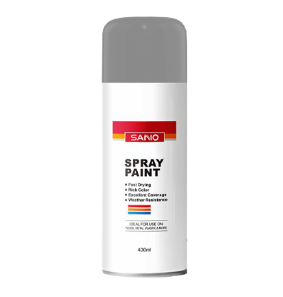
The published specifications for SANVO acrylic spray paint identify acrylic resin, solvent, and pigment as the main components. The product is designed for decoration and appearance repair on metal, wood, and ABS substrates.
This information is useful because formulation determines more than environmental characteristics. It can also influence drying, adhesion, coverage, surface appearance, and compatibility with different substrates.
How Should VOC Claims Be Evaluated?
A responsible evaluation begins with the actual technical documentation. Buyers should ask which VOC definition and testing method support a low-VOC claim, particularly when purchasing for a regulated market.
The EPA notes that VOC measurements can vary depending on the measurement methods used. It also distinguishes between general scientific definitions and regulatory definitions used for specific environmental purposes.
For international B2B purchasing, this matters because a formulation that meets one market’s requirements may need additional verification for another. Documentation should therefore be checked against the destination market and intended application.
What About the Acrylic Spray Paint Formula?
Our acrylic spray paint is described as acid-free, non-toxic, and pH balanced. The product is also positioned for applications involving metal, concrete, wood, laminate, plastic, and glass, with furniture, DIY, and automotive uses listed among its applications.
However, we do not treat the term non-toxic as a substitute for VOC measurement. For buyers specifically seeking low-VOC performance, the applicable technical data should be reviewed against their purchasing specification and local requirements.
This distinction allows customers to assess formulation claims more objectively while still considering the coating’s practical performance.
What Performance Should a Low-VOC Coating Deliver?
Environmental considerations do not eliminate the need for reliable coating performance. Buyers should still examine drying time, adhesion, coverage, color consistency, finish, and substrate compatibility.
The published product parameters specify surface drying in 4 to 5 minutes at 25°C and 60% relative humidity, with full drying within 60 minutes under the same conditions. Available net contents are 250 g/400 ml and 200 g/350 ml.
The product also offers more than 115 standard colors, with customized colors available. This can be useful for distributors and manufacturers that need consistent shades across different products or customer orders.
Why Does Application Method Matter?
VOC exposure and coating performance are affected by how an aerosol is applied. Excessive spraying, poor airflow, and repeated passes can increase the amount of airborne material in the workspace.
Users should therefore follow the product’s application instructions and provide suitable ventilation. A low-VOC formulation does not mean that aerosol mist should be inhaled or that normal chemical-handling precautions can be ignored.
Surface preparation also influences efficiency. A clean, compatible substrate can reduce the need for excessive coating and repeated corrections, helping users achieve the required appearance with a controlled application.
Our Approach to B2B Spray Paint
We develop aerosol coating solutions for customers across hardware, automotive, building-material, retail, and related markets. Our manufacturing capabilities support large-volume orders, while our product range includes different colors and finishes for varied commercial applications.
We also provide customization services covering color, packaging, labeling, and formulation. Additionally, we provide OEM and ODM services tailored to specific business needs.
For buyers with environmental specifications, we recommend discussing the required VOC criteria before finalizing a formula. This allows the product requirements to be evaluated against the intended market instead of relying on a generic low-VOC description.
What Should Businesses Check Before Ordering?
First, define the exact application and target market. A coating for furniture refurbishment may have different requirements from one intended for automotive repair or industrial components.
Next, request the relevant technical and safety documents. These can help verify composition, application conditions, drying performance, and handling requirements. If low-VOC compliance is mandatory, buyers should also confirm the applicable testing method and numerical limit.
Finally, conduct a pilot application. Testing the actual coating on the intended substrate can identify differences in adhesion, finish, drying, and coverage before commercial production or large-volume purchasing.
Choosing Non-Toxic, Low-VOC Spray Paint
A Non-toxic, low-VOC spray paint should be evaluated through separate but connected criteria. The non-toxic claim relates to the formulation’s stated safety characteristics, while VOC evaluation requires attention to the applicable definition, measurement method, and regulatory threshold.
Our acrylic spray paint is officially described as acid-free, non-toxic, and pH balanced, with acrylic resin, solvent, and pigment listed as its main components. It also provides broad substrate compatibility, fast drying, and extensive color options.
For businesses seeking a lower-emission coating solution, we recommend confirming the required VOC specification before selecting a final formula. Combining documented chemical information, application testing, and market-specific compliance checks provides a more reliable basis for choosing the right aerosol coating.