When buyers search for Non-toxic water-based spray paint, they are often looking for a coating that combines convenient aerosol application with a formulation that may better suit their environmental or workplace goals. However, water-based, non-toxic, and low-odor are different characteristics. Understanding these distinctions is important before choosing a coating for commercial, decorative, or industrial use.
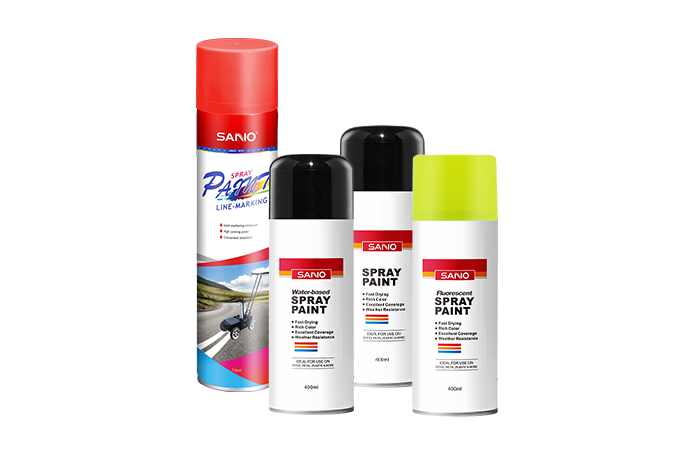
What Is Water-Based Spray Paint?
Water-based spray paint uses water as a major component of its liquid carrier system rather than relying primarily on organic solvents. Depending on the formulation, it can contain resins, pigments, additives, propellants, and other ingredients required to create a stable aerosol.
The term water-based does not mean that water is the only ingredient. The finished product still needs a carefully balanced formulation to provide adequate atomization, adhesion, drying, and film formation.
For this reason, buyers should review the actual technical specifications instead of assuming that every product advertised as environmentally friendly is water-based. The formulation and safety documentation provide a more reliable basis for comparison.
Is Water-Based Spray Paint Automatically Non-Toxic?
No. Water-based and non-toxic describe different properties. A water-based coating may reduce reliance on certain organic solvents, but this alone does not establish that the finished product has no health hazards.
Similarly, a product described as non-toxic still needs to be handled according to its instructions. Aerosol application creates airborne droplets, and the complete formulation may contain substances requiring appropriate precautions.
This distinction is especially important for B2B purchasers. If a customer specification requires a Non-toxic water-based spray paint, both the water-based formulation and the relevant safety characteristics should be verified separately through product documentation.
What Are the Potential Advantages of Water-Based Formulations?
One reason buyers investigate water-based coatings is the potential to reduce the amount of conventional organic solvent used in a formulation. Depending on the formula and application, this can support goals involving odor, emissions, workplace conditions, or environmental preferences.
However, performance remains essential. A coating must still form a suitable film and provide the adhesion, appearance, coverage, and durability required for its intended use.
Water-based aerosol technology can therefore involve a different formulation balance from conventional solvent-based spray paint. Manufacturers need to consider factors such as drying conditions, resin compatibility, pigment dispersion, propellant selection, and packaging stability.
How Should Buyers Compare Formulations?
The first step is to identify the actual application. A coating for decorative furniture may have different requirements from one intended for automotive touch-ups or hardware components.
Next, compare the product’s main components, VOC information where applicable, drying performance, substrate recommendations, and safety documentation. If water-based technology is a purchasing requirement, ask the supplier to confirm it directly rather than inferring it from terms such as eco-friendly or non-toxic.
Testing is also valuable. Temperature, humidity, substrate condition, spray distance, and coating thickness can influence the performance of an aerosol. A small trial can reveal whether the formulation meets the required finish and drying characteristics before larger-scale adoption.
How Does SANVO Approach Aerosol Development?
SANVO develop aerosol products for customers in automotive, hardware, building-material, retail, and related markets. Our aerosol range includes acrylic spray paint as well as other specialized formulations, and our custom aerosol services include acrylic, water-based, toluene-free, and lead-free options.
This distinction is important when evaluating the acrylic spray paint featured for this article. Its official product specification identifies acrylic resin, solvent, and pigment as its main components, so it should not be inaccurately described as a water-based formulation.
For customers specifically seeking water-based technology, we can discuss formulation requirements through our customized aerosol development services. This allows the desired formulation to be evaluated separately from the standard acrylic product.
What Are the Specifications of the Acrylic Spray Paint?
The standard acrylic spray paint is designed for decoration and appearance repair on metal, wood, and ABS substrates. The product information also identifies applications involving plastic, vinyl, fiberglass, and other surfaces. It features an adjustable easy-press nozzle and a wide spray pattern for producing smooth, even coats.
Its published parameters specify surface drying in 4 to 5 minutes at 25°C and 60% relative humidity, with full drying within 60 minutes under the same conditions. Available net-content options are 250 g/400 ml and 200 g/350 ml.
The product is described as acid-free, non-toxic, and pH balanced. It also offers more than 115 standard colors, with customized colors available. These specifications can be useful when comparing general-purpose aerosol coatings for commercial applications.
What Should Businesses Consider Beyond the Formula?
For B2B customers, formulation is only one part of the purchasing decision. Packaging, color consistency, production capacity, regulatory requirements, application performance, and customization can all affect the suitability of an aerosol product.
We support OEM and ODM projects and provide customization involving colors, packaging, labeling, accessories, and formulas. Our published capabilities also include custom water-based spray paint, giving customers a route to discuss requirements that differ from the standard acrylic formulation.
This approach can be particularly useful for distributors and retailers developing private-label aerosol products. Instead of assuming that one formulation fits every market, buyers can define the required characteristics before moving into testing and production.
How Should a Water-Based Spray Paint Be Tested?
A pilot test should cover more than color. Apply the coating to the actual substrate and evaluate atomization, coverage, adhesion, drying, appearance, and compatibility with any existing finish.
Environmental conditions should also be recorded during testing. A coating tested in a warm, dry environment may behave differently under higher humidity or lower temperatures.
For commercial projects, testing should ideally use the intended can, nozzle, formulation, and packaging configuration. This helps identify potential problems before production quantities are ordered.
Choosing Non-Toxic Water-Based Spray Paint
A Non-toxic water-based spray paint should be selected through verified formulation information rather than marketing terminology alone. Water-based technology and non-toxic claims should each be evaluated according to the product’s documented specifications and the requirements of the intended market.
Our standard acrylic spray paint is a solvent-containing acrylic formulation, while our custom aerosol capabilities include water-based options. Keeping these product categories distinct helps customers choose the appropriate technology without confusing one formulation with another.
For businesses seeking a water-based aerosol solution, we recommend defining the required formulation, substrate, performance targets, and compliance criteria first, followed by pilot testing. This process provides a clearer path toward a coating that meets both application needs and purchasing expectations.