Clear floor and pavement markings do more than divide physical space; they create a visual language that helps people understand where to walk, drive, store materials, or carry out specific tasks. A well-planned acrylic line marker spray paint application can provide sharp boundaries while keeping commercial areas easier to navigate and maintain. From industrial floors to parking areas, the coating has to work alongside the site’s layout, surface condition, traffic patterns, and maintenance routine.
At SANVO, we approach these requirements from both a formulation and service perspective, recognizing that commercial coating projects often involve technical specifications, customized requirements, production coordination, and after-sales support.
Understanding The Role Of Acrylic Marking Coatings
Acrylic formulations are frequently considered for marking work because they can provide fast drying and practical surface coverage. Those characteristics become particularly useful in places where painted areas cannot remain inaccessible for long periods. However, drying speed represents only one part of performance; adhesion, film consistency, surface preparation, and resistance to everyday wear also influence the service life of a marking system.
The substrate changes the way a coating behaves. Concrete may have pores and surface dust that require careful preparation, while asphalt has a different texture and flexibility. Painted industrial floors can introduce another variable because the new material must interact appropriately with an existing coating rather than simply bond to bare mineral material.
Application conditions matter as well. Temperature, humidity, ventilation, spray distance, and coating thickness can all affect the final appearance. A consistent process generally produces more predictable lines than relying on heavy application to obtain stronger visual contrast.
Where Line Marking Applications Make A Difference
Warehouses often contain forklifts, pedestrian routes, storage locations, loading points, and restricted areas within the same facility. Distinct markings help separate these functions visually, allowing employees and visitors to interpret the layout more quickly. The paint itself becomes part of a broader workplace organization system rather than an isolated decorative feature.
Parking facilities have their own priorities. Bay boundaries, directional arrows, pedestrian crossings, access lanes, and restricted zones must remain recognizable despite vehicle movement and exposure to dirt, moisture, sunlight, and tire friction. A marking strategy should consider both visibility and the physical demands placed on each section.
Sports facilities require another type of precision. Court or field markings define usable areas and influence how participants understand boundaries during play. Line width, color contrast, placement accuracy, and surface compatibility all deserve attention, particularly where regular cleaning or outdoor exposure can gradually affect the painted film.
Balancing Product Requirements With Project Conditions
A specification should begin with the environment rather than the product label. Indoor factories may prioritize rapid access after application, whereas an outdoor project could place greater emphasis on weather exposure and surface characteristics. The same marking material may perform differently depending on where and how it is applied.
Color selection also has a functional purpose. Yellow, white, and grey can serve different visual roles according to the site’s internal marking system. More important than selecting a color in isolation is establishing a consistent visual code so that workers can understand what a particular line, boundary, or zone represents.
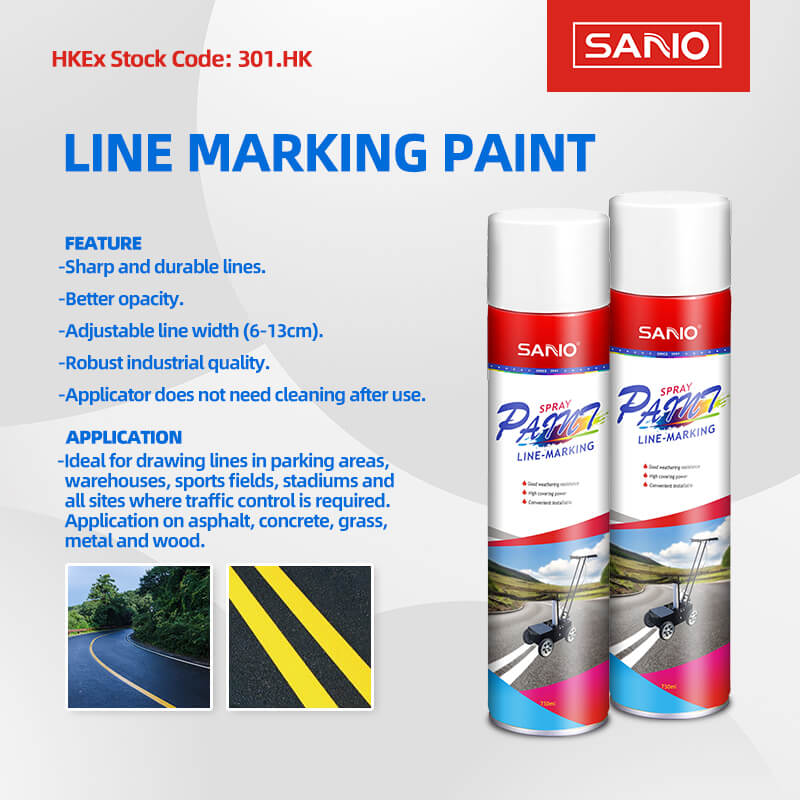
Our SANVO Line Marking Paint is an acrylic-based, fast-drying formulation developed for long-lasting lines, with yellow, white, and grey options. We offer it for applications including car parks, factories, warehouses, sporting fields, and courts, while our broader manufacturing and service capabilities allow commercial customers to discuss specifications and project requirements with our team.
Why OEM And ODM Support Matters For Commercial Projects
Large commercial coating programs do not always fit standard purchasing requirements. A distributor may need particular packaging, a brand may require its own labeling, or an importer may have market-specific regulatory and documentation requirements. OEM services can address these variables while keeping the underlying production process coordinated.
ODM projects may involve greater input from the manufacturer in product design and development, depending on the customer’s requirements. Technical discussions may cover application characteristics, packaging configuration, product specifications, and other project details before manufacturing begins. Such collaboration can be useful when an existing catalog product does not match the exact commercial requirement.
We at SANVO provide OEM and ODM services backed by our chemical manufacturing experience and R&D resources. Our role can extend from consultation and product development through production, distribution coordination, and after-sales communication, giving business customers a more connected route from an initial coating concept to a market-ready solution.
Conclusion
Ground markings may appear simple, yet their practical value comes from the interaction between coating chemistry, surface preparation, site design, application technique, and ongoing maintenance. A suitable acrylic line marker spray paint solution can contribute to clearer traffic routes, better-defined work zones, and more readable recreational spaces when those factors are considered together. We at SANVO combine manufacturing knowledge with OEM, ODM, global-agent, and after-sales capabilities so that commercial projects can address both material requirements and broader supply needs. Thoughtful planning ultimately makes painted markings more useful because the coating becomes part of a coherent system rather than merely a line on the floor.