The underside of a vehicle faces constant exposure to road debris, moisture, salt, and contaminants that slowly degrade metal surfaces. Undercoating spray for cars is a protective coating applied to the chassis, wheel wells, and undercarriage to create a barrier against these threats. For anyone focused on long-term vehicle maintenance, understanding what undercoating does and why it matters is a practical starting point before the damage becomes visible.
What Is Undercoating Spray for Cars?
Undercoating is a spray-applied protective layer designed to shield the undercarriage of a vehicle from rust, corrosion, impact damage, and road noise. While the top surfaces of a car receive regular attention through washing and waxing, the underside is often neglected despite being directly exposed to some of the harshest road conditions.
Modern undercoating sprays are generally classified into two main types: water-based and oil-based formulations, each designed for different performance requirements and application environments.
Water-based undercoatings typically offer lower VOC emissions and faster drying times, making them suitable for applications where environmental considerations and ease of use are prioritized. Oil-based undercoatings, on the other hand, are formulated with petroleum-derived components that provide stronger adhesion, improved moisture resistance, and longer-lasting protection under harsh driving conditions.
Regardless of formulation type, undercoating products commonly contain rust inhibitors and protective agents that form a durable, elastic film after application, helping prevent moisture penetration and surface oxidation.
What Areas Does Undercoating Protect?
- Chassis and frame: The structural backbone of the vehicle that is highly exposed to long-term moisture and road salt exposure. Undercoating helps form a protective barrier that reduces direct metal contact with corrosive elements, helping maintain structural integrity over time
- Wheel wells: Constantly exposed to mud, salt, gravel, and road spray. A protective coating helps reduce abrasion damage and minimizes corrosion caused by trapped moisture and contaminants in hard-to-clean areas
- Underbody panels: Frequently impacted by stones and road debris during driving. Undercoating provides an additional protective layer that helps absorb minor impacts and reduce surface chipping that can lead to rust formation.
- Floor pan: Vulnerable to moisture intrusion through seams and joints. Undercoating helps seal exposed surfaces, reducing the risk of hidden corrosion developing beneath interior flooring over time.
- Frame rails and crossmembers: Structural load-bearing components that also experience vibration stress and moisture accumulation. Undercoating helps protect these areas by reducing direct exposure to corrosive environments and supporting long-term structural durability.
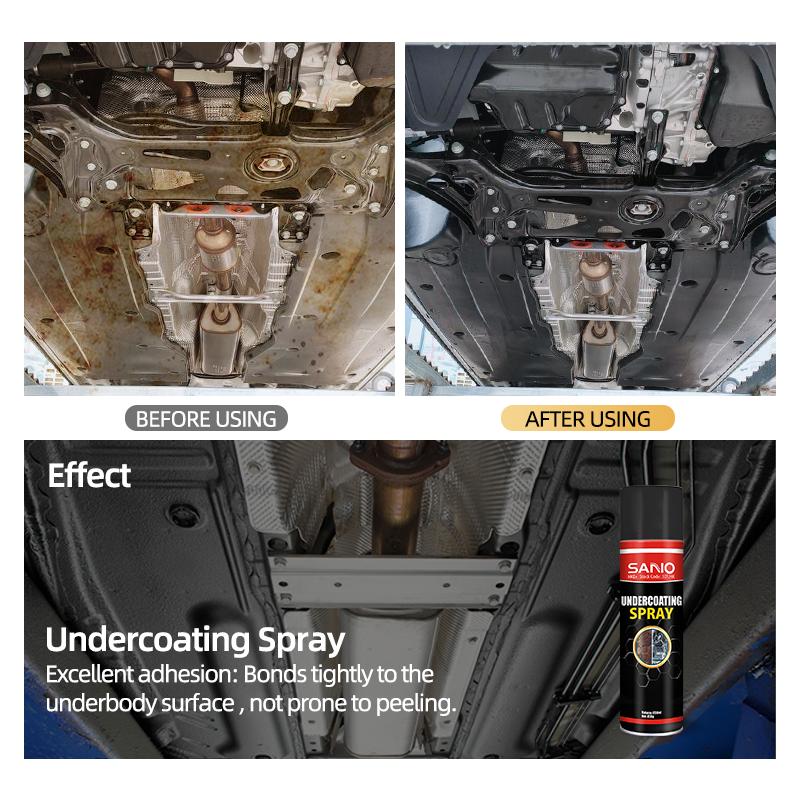
Why Rust and Corrosion Are Serious Threats
Rust forms when iron-containing metal reacts with oxygen and moisture. The undercarriage of a vehicle is exposed to this process every time it is driven, accelerated by road salt used in winter conditions, standing water in parking areas, and humid climates.
Corrosion weakens a vehicle’s structural integrity over time and can affect critical components including the suspension, steering linkage, brake lines, exhaust system, and fuel lines. What begins as surface oxidation gradually penetrates deeper into metal, eventually compromising both safety and resale value.
Applying undercoating for cars interrupts this process by forming a physical barrier that blocks direct contact between bare metal and the moisture and oxygen that trigger oxidation.
The Dual Function: Rust Prevention and Noise Reduction
While corrosion protection is the primary purpose of undercoating, the coating layer also interacts directly with another important aspect of underbody performance—vibration and road noise control. Because both issues originate from the vehicle’s constant exposure to harsh road conditions, they are often addressed simultaneously by the same protective film.
One of the most practical advantages of a quality undercoating spray is that it addresses two separate problems simultaneously.
Corrosion Protection
The coating seals metal surfaces against moisture, salt, road chemicals, and grime. Once cured, it forms a stable, elastic layer that does not crack easily under vibration or thermal cycling, ensuring the barrier remains intact through seasonal temperature changes.
Noise and Vibration Dampening
The elastic nature of undercoating materials allows the coating to absorb and dissipate mechanical vibrations from the road surface before they travel through the chassis into the cabin. This reduces road noise, rattling from loose gravel impact, and the drumming sounds caused by wheel well resonance. Vehicles treated with a thick, high-solids undercoating typically deliver a noticeably quieter and more composed ride.
When and How Often Should Undercoating Be Applied?
The optimal time to apply automotive undercoating is before rust has formed, ideally on a new or recently cleaned vehicle. Applying undercoating over active rust can trap oxidation beneath the coating, accelerating damage rather than preventing it.
Recommended Scenarios for Application
- New vehicle purchase, before the first winter season
- After professional rust removal or chassis preparation
- Following a vehicle inspection that reveals areas of thinning factory undercoating
- As part of annual maintenance in regions with heavy road salt use or high humidity
Most automotive professionals recommend inspecting the undercarriage annually and reapplying undercoating as needed, particularly in climates with harsh winters or coastal salt air exposure.
SANVO Under Coating Spray: Built for Automotive and Industrial Protection
SANVO offers an aerosol-format undercoating spray engineered for both automotive chassis protection and broader industrial applications.
The SANVO Under Coating Spray is formulated primarily with DME, xylene, and toluene, combined with rust inhibitors and lubricants to deliver comprehensive multi-functional metal protection in a single product.
Because the formulation contains fast-evaporating aromatic solvents with high volatility, the product is intended for well-ventilated industrial or outdoor application environments and should be used in accordance with standard occupational safety practices.
Product Features
- Effective rust prevention: Actively inhibits oxidation on metal surfaces, protecting the chassis and undercarriage from moisture and road chemicals
- Excellent elasticity: Cures into a flexible coating that absorbs impact and resists cracking under vibration, thermal changes, and physical stress
- Noise elimination: The elastic coating layer dampens road noise and reduces vibrations transmitted through the chassis into the cabin
- Corrosion resistance: Provides lasting resistance against salt, moisture, and environmental contaminants
- High solid content: Thick coating formation ensures thorough surface coverage with reliable adhesion
During application, standard protective measures are recommended, including the use of gloves, protective eyewear, and adequate ventilation. Prolonged inhalation of spray mist should be avoided, and application should be performed away from open flames or ignition sources due to the volatile nature of solvent-based formulations.
The product is designed for professional or semi-professional use in controlled environments where proper spraying procedures and safety practices are followed, ensuring both effective coating performance and safe handling.
With over 30 years of fine chemical manufacturing experience and seven professional production bases, SANVO supplies automotive and industrial protection products to global markets with complete quality certifications.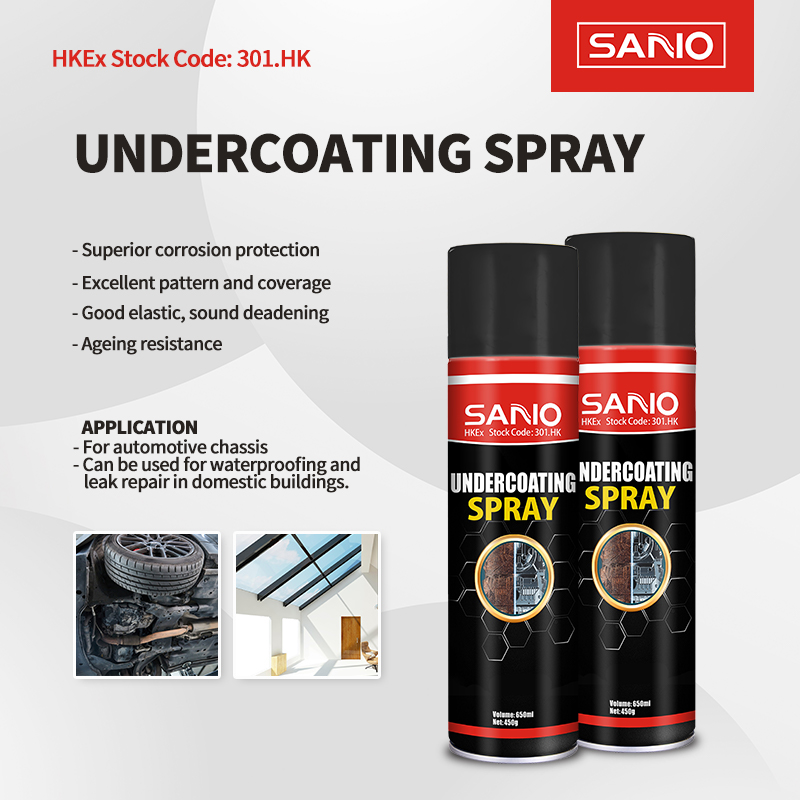
Conclusion
Undercoating spray is a practical solution for protecting vehicle underbodies from long-term exposure to moisture, road salt, and mechanical impact, while also helping reduce vibration-related noise for improved driving comfort.
As discussed above, effective protection depends not only on choosing the right formulation, but also on proper application timing and maintenance intervals—typically before rust formation, with periodic inspection and reapplication based on driving environment and coating condition.
For automotive buyers and distributors looking for a technically reliable and application-ready solution, the SANVO Under Coating Spray offers durable chassis protection in an aerosol format designed for consistent performance and efficient field use.
For product specifications, application guidance, or bulk procurement inquiries, contact SANVO to learn more about suitable solutions for your market needs.