Routine automotive maintenance requires precise chemical solutions to maintain mechanical reliability and preserve vehicle aesthetics. Using a targeted car care spray enables technicians and vehicle owners to service individual components directly without the need to dismantle complex assemblies.
Implementing an organized car care spray routine minimizes component wear, lowers repair expenses, and prevents premature mechanical failure. This guide examines the six essential aerosol formulations required for standard mechanical servicing and detailing upkeep.
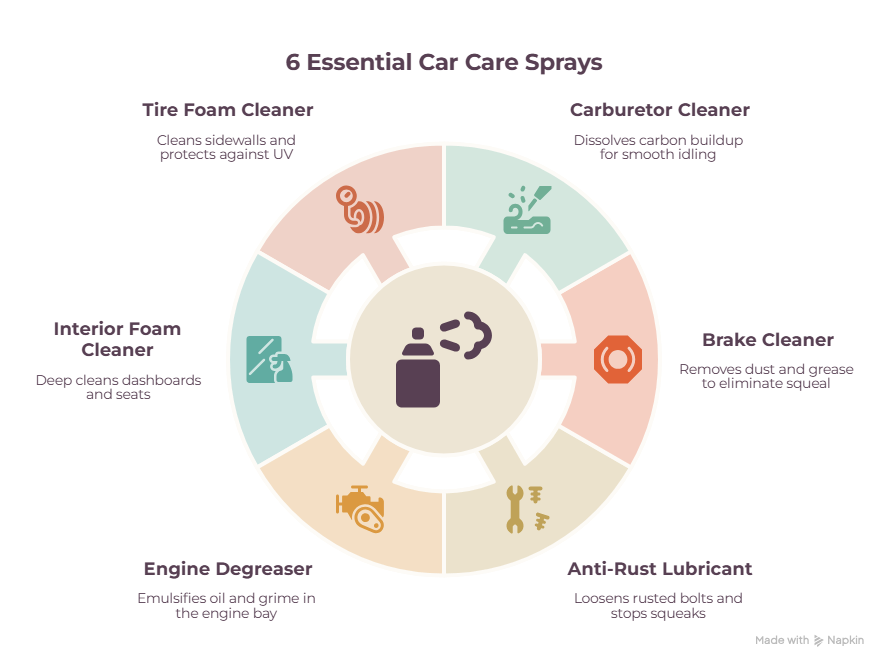
The 6 Essential Car Care Sprays
1. Carburetor & Throttle Body Cleaner
Internal combustion engines accumulate heavy varnish, gum, and carbon deposits inside air intake passages over extended operational hours. These deposits restrict airflow, disrupt fuel atomization, and cause irregular idling or sluggish throttle response.
A dedicated carburetor and throttle body cleaner dissolves stubborn carbon layers and fuel gum without requiring complete intake manifold disassembly. Regular application cleans the butterfly valve seat, which restores designed air-fuel mixture ratios and stabilizes engine idle speeds.
2. Brake & Parts Cleaner
Braking systems generate high volumes of metallic friction dust, road dirt, and grease that settle on calipers, drums, and rotor surfaces. Accumulations of friction dust and brake fluid residue degrade braking friction coefficients and cause audible brake squeal.
Applying a specialized brake parts cleaner flushes contaminants away from the contact points and evaporates without leaving oily films. Consequently, clean friction surfaces deliver consistent stopping distances and prevent caliper slide pins from binding.
3. Multi-Purpose Anti-Rust Lubricant Spray
Underbody fasteners, suspension pivot bolts, and door hinges continuously suffer from oxidation caused by moisture, road brine, and humidity. Rusted threads often seize, which complicates standard disassembly and risks bolt shearing during maintenance.
A multi-purpose anti-rust car lubricant utilizes low surface tension to penetrate micro-fissures in seized threads by capillary action. The formulation displaces standing water, leaves a durable corrosion-inhibiting barrier, and silences squeaks across mechanical linkages.
4. Heavy-Duty Engine Surface Degreaser
Engine bays accumulate layers of motor oil mist, coolant residue, and road grime that bake onto metal and composite housings at high underhood temperatures. Heavy sludge accumulation impedes heat dissipation from engine blocks and conceals early fluid leaks.
A heavy-duty engine surface degreaser contains concentrated surfactants that emulsify baked petroleum deposits upon contact. After soaking for several minutes, the loosened emulsion rinses away clean with water, this allows clear visual inspection of engine gaskets and hoses.
5. Multi-Purpose Interior Foam Cleaner
Vehicle cabins contain a mix of diverse materials, including polyvinyl chloride (PVC) dashboards, polyurethane trim, and woven fabric upholstery. These surfaces absorb skin oils, spill residues, and airborne dust particles over daily commuting cycles.
A specialized spray foam cleaner for cars expands across textured surfaces, lifting embedded soil away from textile fibers without saturating the underlying foam cushions. Users can wipe the suspended dirt away using a microfiber towel, this avoids water stains and surface degradation.
6. Tire Foam Cleaner & Protectant
Elastomeric tire sidewalls experience continuous degradation caused by ground-level ozone, dirt accumulation, and ultraviolet (UV) radiation. Over extended periods, this exposure leads to polymer oxidation, sidewall browning, and superficial micro-cracking.
A tire foam cleaner and protectant strips road grime while depositing a protective organosilicone film on the sidewall rubber. This coating shields the elastomer against solar UV radiation, prevents sidewall discoloration, and produces a uniform deep black finish.
Key Selection & Quality Standards
Solvent Purity and Valve Reliability
Formulation purity determines whether an aerosol cleaner operates safely inside modern vehicles. Aerosol cleaners must utilize high-purity chemical bases that leave no measurable residue upon evaporation. Impure propellants or heavy solvent carriers can contaminate sensitive electronic elements and trigger diagnostic trouble codes.
Container integrity is equally critical for storage stability across seasonal temperature fluctuations. High-grade tinplate cans resist internal pressure variations and structural deformation. Furthermore, integrated 360-degree spray valves allow technicians to dispense products upside down inside confined engine compartments and wheel arches.
Manufacturing Scale and Quality Control
Partnering with an established chemical manufacturer ensures that every aerosol container complies with stringent industrial standards. SANVO Fine Chemicals operates high-capacity automated aerosol production lines equipped with automated hot-water bath leak testing to verify can seal integrity.
Production facilities at SANVO operate under International Organization for Standardization (ISO) 9001 quality management and International Automotive Task Force (IATF) 16949 automotive quality standards. These systematic controls ensure precise propellant charging, stable can pressure, and uniform spray atomization across every manufacturing batch.
Supply Chain Consolidation and Product Portfolio Advantages
Automotive distributors and fleet maintenance centers achieve significant operational efficiencies by consolidating chemical procurement with an integrated manufacturer. The SANVO product portfolio spans mechanical car care spray formulations, functional lubricants, and exterior finishing solutions such as spray paint for cars.
In addition to standardized formulations, SANVO offers original equipment manufacturer (OEM) and original design manufacturer (ODM) capabilities. Technical teams can customize solvency, evaporation rates, and propellant mixtures to satisfy regional volatile organic compound (VOC) environmental regulations.
Frequently Asked Questions (FAQ)
Q1: Can I use brake cleaner to clean a carburetor or throttle body?
Brake cleaner should not be applied to throttle bodies. Brake cleaners often contain aggressive non-chlorinated or chlorinated solvents that degrade the protective molybdenum coatings inside modern throttle bores. In contrast, dedicated throttle body cleaners use milder solvent systems that dissolve varnish without stripping internal coatings or damaging synthetic shaft seals.
Q2: Are automotive aerosol cleaners safe for modern electronic sensors and catalytic converters?
Only cleaners labeled as sensor-safe should be applied near intake sensors and exhaust components. Solvents containing harsh aromatic compounds can coat or break the fine platinum wire elements inside mass airflow (MAF) sensors. Furthermore, excessive chemical residues drawn into combustion chambers can foul catalytic converter substrate coatings.
Q3: How often should I use anti-rust penetrating spray on the vehicle undercarriage?
Anti-rust penetrating spray should be applied biannually during pre-winter preparation and post-winter undercarriage inspections. Vehicles operating in coastal environments or cold regions where road maintenance crews apply de-icing salts benefit from quarterly applications on exposed suspension links, subframe bolts, and exhaust hangers.
Q4: Will engine degreaser damage rubber hoses, wiring harnesses, or aluminum parts?
Engine degreasers should not degrade synthetic ethylene propylene diene monomer (EPDM) rubber hoses or polyethylene wire looms when rinsed within the manufacturer’s dwell time. However, users must avoid leaving highly alkaline cleaners on bare aluminum for extended periods, as prolonged contact can cause surface oxidation and staining.
Q5: Can a multi-purpose interior foam cleaner be used on both leather and fabric seats?
Neutral-pH interior foam cleaners operate safely on both synthetic woven fabrics and coated automotive leather. Because natural leather requires preserved moisture levels, technicians should wipe the foam away promptly with a clean cloth and apply a dedicated leather conditioner to restore essential oils.