Spray painting indoors requires more careful product selection than painting in an open outdoor area. Conventional solvent-based aerosol coatings can release noticeable odors and volatile organic compounds, or VOCs, during spraying and drying. Because indoor air exchange is limited, these emissions can remain concentrated around the work area.
For this reason, people searching for non toxic spray paint should look beyond the wording on the front of the can. Water-based chemistry, VOC information, ingredient disclosures, substrate compatibility, and relevant safety documentation provide a more useful basis for comparison.
What Does “Non-Toxic Spray Paint” Actually Mean?
“Non-toxic” is not a universal technical classification for aerosol paint. A more practical approach is to evaluate several measurable characteristics together.
Water-based or waterborne formulations generally use water as a major part of the carrier system rather than depending primarily on organic solvents. However, water-based paint can still contain resins, pigments, additives, co-solvents, and aerosol propellants.
The United States Environmental Protection Agency also notes that a “low VOC” or “no VOC” claim alone does not prove that a product is harmless indoors. Individual chemical ingredients and exposure conditions still matter. Good ventilation and compliance with the product label and Safety Data Sheet, or SDS, remain important.
Core Selection Criteria: How to Choose the Right Indoor Spray Paint
1. Check the Base Chemistry
The first criterion is whether the coating is water-based or solvent-based.
Waterborne acrylic coatings use water as an important part of the formulation while acrylic resin creates the final paint film. This design can reduce dependence on traditional organic solvents while still providing adhesion, color coverage and surface protection.
SANVO’s Water-based Aerosol Spray Paint, for example, lists water-based acrylic resin, pigment, deionized water, ethanol, propylene glycol methyl ether and dimethyl ether, or DME, among its ingredients. Its TDS describes the formulation as low odor and low in VOC content and identifies it as suitable for indoor applications.
This illustrates why reviewing spray paint ingredients is more informative than relying only on labels such as “green” or “eco.”
2. Compare VOC and Odor Information
VOC means volatile organic compound. These compounds can evaporate into indoor air during application and drying.
When choosing low-VOC spray paint, check whether the manufacturer provides an SDS or TDS rather than relying only on a low-odor claim. Odor and VOC content are related considerations, but they are not identical.
A water-based, low-odor formulation can be more practical for furniture, craft and maintenance projects in occupied buildings. Even so, windows should be opened where possible, fresh air should move through the room, and the manufacturer’s respiratory and personal protective equipment instructions should be followed.
The EPA specifically recommends increased ventilation when painting or using products that release VOCs indoors.
3. Match the Paint to the Surface
A coating can have a favorable emissions profile and still be unsuitable if it does not bond correctly to the intended substrate.
Check the technical sheet for materials such as wood, painted drywall, metal, ABS plastic or foam. Surface compatibility affects adhesion, film integrity and long-term appearance.
SANVO’s water-based aerosol TDS specifies applications including metal, wood, walls, ABS and styrene foam. This makes the formulation relevant to several common indoor repair and decorative applications rather than a single material category.
For glossy plastic, coated metal or previously painted furniture, a small adhesion test is still advisable.
4. Review Safety and Regulatory Documentation
Regulatory terms should be interpreted carefully.
REACH, or Registration, Evaluation, Authorisation and Restriction of Chemicals, is the European Union framework governing chemical risks and safety information. It is relevant when assessing chemical substances and mixtures supplied to the European market.
RoHS, or Restriction of Hazardous Substances, limits specified substances in electrical and electronic equipment. Therefore, RoHS information can be relevant to coatings used on applicable components, but it should not be treated as a general certification that every paint is safe for every household application.
For children’s products, buyers may also encounter EN 71-3, the European toy safety standard dealing with the migration of specified elements. If a painted item will be used as a toy, crib component or another child-contact product, request documentation specifically applicable to that formulation and intended use.
Top Recommended Non-Toxic Spray Paint Solutions
Best Overall for Indoor Furniture & Home Decor: SANVO Water-Based Eco Spray Paint
For indoor furniture, doors, frames and decorative objects, a water-based acrylic aerosol is a practical starting point.
SANVO Water-based Aerosol Spray Paint is formulated with water-based acrylic resin and is described in its technical documentation as low odor and low VOC. The product is specified for indoor use and for materials including wood, metal, walls and ABS. Its listed touch-dry time is 15 to 25 minutes at the stated test conditions, with a hard-dry time of approximately 4 hours.
These characteristics can suit decorative indoor work where solvent odor and indoor emissions are important purchasing considerations.
Chalk-Style Low-Odor Spray Paint for Vintage Finishes
For distressed furniture and ultra-matte decorative finishes, consider a low-odor chalk-style aerosol.
The main selection points should be substrate compatibility, VOC documentation and whether the finish can tolerate routine handling. Decorative appearance should not replace evaluation of the coating’s chemical documentation.
Low-VOC Water-Based Clear Coat for Protection
Painted furniture and craft pieces may also require a transparent protective layer.
A water-based acrylic clear coat can help provide additional scratch and moisture resistance without introducing the same solvent profile associated with many traditional clear lacquers. The clear coat should be compatible with the underlying color coat and allowed to cure for the period specified by its manufacturer.
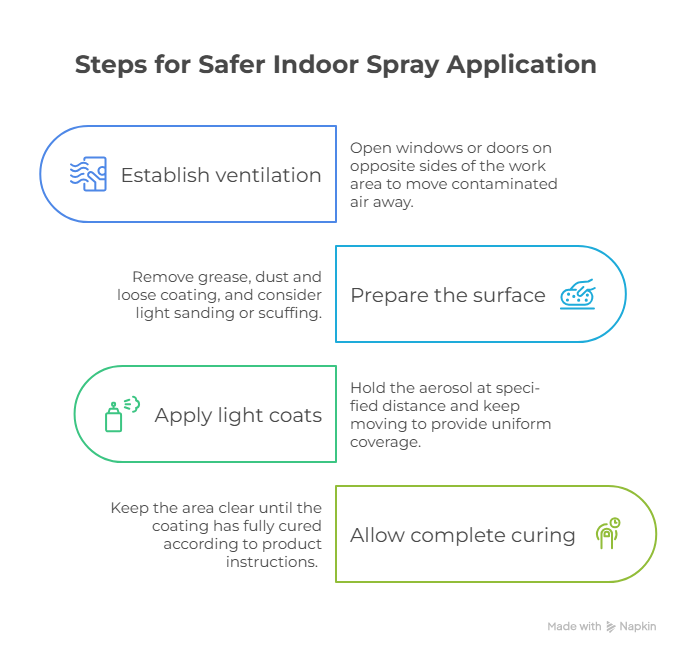
4 Steps for Safer Indoor Spray Application
Step 1: Establish ventilation
Open windows or doors on opposite sides of the work area where possible. Use airflow to move contaminated air away from occupants rather than circulating spray mist around the room.
Step 2: Prepare the surface
Remove grease, dust and loose coating. Light sanding or scuffing may improve mechanical adhesion on smooth surfaces. Always check whether the substrate requires a specific primer.
Step 3: Apply several light coats
Hold the aerosol at the distance specified by the manufacturer and keep the can moving during application. Multiple thin coats generally provide more uniform coverage and reduce runs compared with one heavy coat.
Step 4: Allow complete curing
Drying and curing are not the same process. A surface may feel dry while the coating is still developing hardness. Keep children and pets away from the work area until spraying is complete, ventilation has removed residual odor, and the coating has cured according to the product instructions.
Frequently Asked Questions
Q1: Is water-based spray paint safe to use indoors?
Water-based spray paint is generally lower in odor and VOCs than traditional solvent-based paint. However, good ventilation and proper protective measures are still recommended.
Q2: Is water-based non-toxic spray paint durable?
Yes, water-based acrylic spray paint can provide good adhesion and durability when the surface is properly prepared and the coating is fully cured.
Q3: Does non-toxic spray paint have a strong smell?
Usually not. Low-VOC spray paint typically produces less odor than conventional solvent-based aerosol paint, although some smell may still be present during application.
Q4: Can I use non-toxic spray paint on children’s toys, cribs, or pet furniture?
Only if the specific product is approved for that intended use. Check applicable safety standards and product documentation before using it on items that children or pets may touch, lick, or chew.
Q5: Do I need a primer before applying water-based spray paint?
It depends on the surface. Bare metal, some plastics, and highly absorbent materials may require a compatible primer, while prepared wood or previously painted surfaces may not.